


India's FDI Policy 2026
Introduction: India's FDI Landscape — A Strategic Pivot
India has emerged as one of the world's most dynamic destinations for foreign direct investment. According to the Department for Promotion of Industry and Internal Trade (DPIIT), India attracted USD 70.95 billion in total FDI inflows in FY 2023–24, reaffirming its position as a preferred global investment destination. Since 2000, India has cumulatively received over USD 1 trillion in FDI, with the services sector, computer software, hardware, telecommunications, and trading being among the largest recipients.
Against this backdrop of robust inflow ambitions, India's FDI architecture has evolved from a predominantly liberal, open-door framework to one that increasingly incorporates strategic guardrails — particularly in the context of investments originating from, or linked to, countries sharing land borders with India.
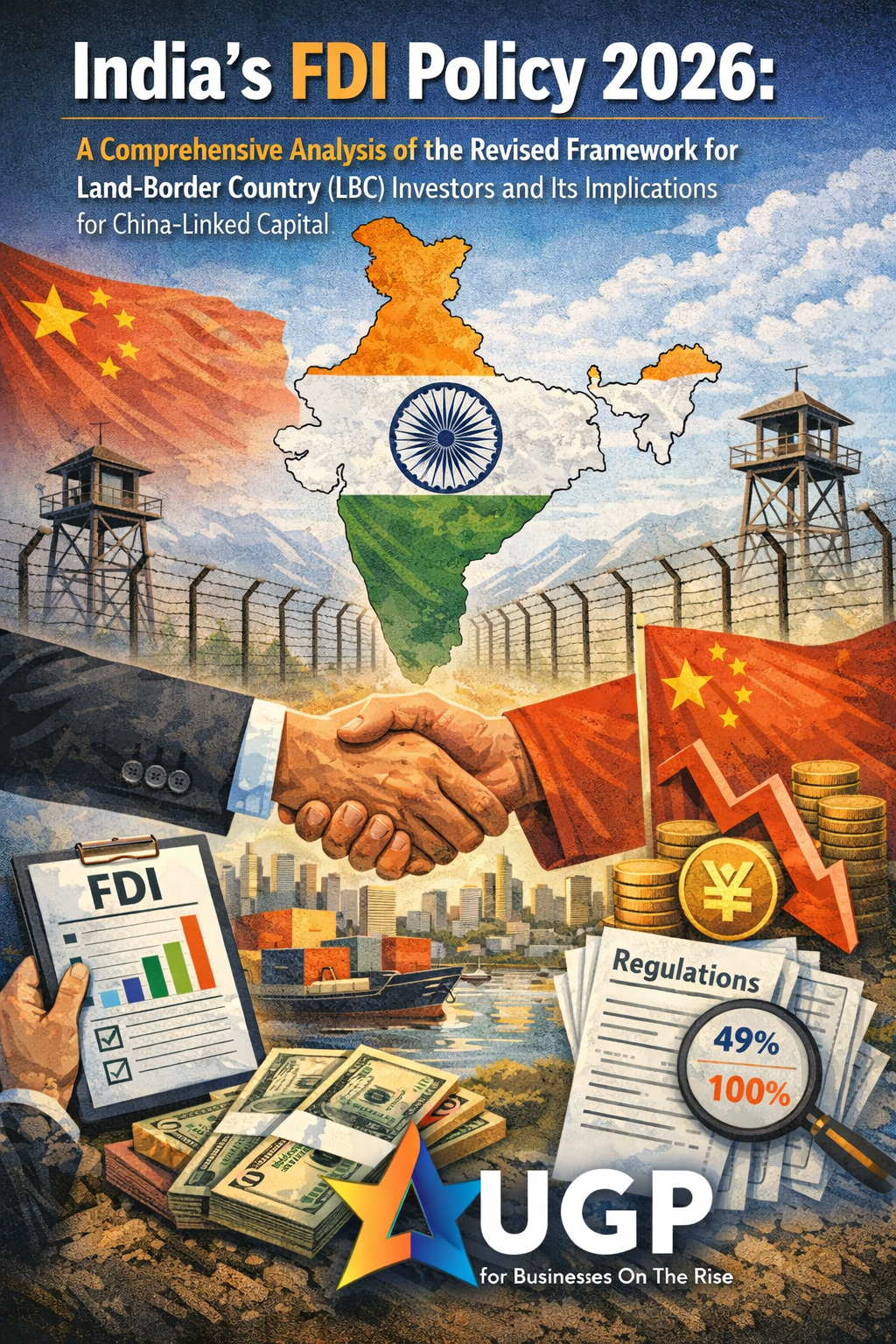
India's revised FDI policy (2026) allows foreign investors with up to 10 percent ownership from land-border countries (LBC), including China-linked capital, to invest under the automatic route, subject to sectoral caps and conditions. However, any investment involving control, Hong Kong-incorporated entities, or sensitive sectors still requires government approval under Press Note 3 (PN3).
Historical Context: The Origins of Press Note 3
To understand the significance of the 2026 amendments, it is important to trace the origins of the regulatory framework they seek to modify.
Press Note 3 (2020) was issued by DPIIT in April 2020 during the height of the COVID-19 pandemic. It mandated prior government approval for all FDI originating from or routed through countries that share a land border with India. The countries affected include China, Pakistan, Bangladesh, Nepal, Myanmar, Bhutan, and Afghanistan — collectively referred to as Land Border Countries (LBCs).
The move was explicitly designed to:
- Prevent opportunistic takeovers of Indian companies at depressed pandemic-era valuations.
- Address growing concerns over Chinese acquisitions in the Indian startup and technology ecosystem.
- Align with similar safeguards adopted by the European Union, Australia, and the United States during the same period.
At the time of its introduction, Chinese entities had significant stakes in several high-profile Indian companies. Notably:
- Alibaba had investments in Paytm, Zomato, Snapdeal, and BigBasket.
- Tencent was invested in Ola, Flipkart, and Byju's.
- ByteDance, Xiaomi, OPPO, and other Chinese firms had substantial operational and capital presence in India.
Following the Galwan Valley clash (June 2020) between Indian and Chinese military forces, and subsequent diplomatic tensions, the already cautious framework hardened further. India banned over 200 Chinese mobile applications and intensified scrutiny of Chinese investment proposals. Between 2020 and 2025, approximately 150+ FDI proposals from China were reportedly pending approval, many stuck in regulatory queues for years.
Why 2026 Marks a Turning Point
India's 2026 FDI policy revision reflects a measured recalibration — one rooted in pragmatism, supply chain strategy, and diplomatic normalization.
Diplomatic Normalization
Following a significant thaw in India-China relations, including:
- The disengagement agreement at Depsang and Demchok (October 2024) that effectively resolved the most contentious military standoffs along the Line of Actual Control (LAC),
- High-level meetings between Prime Minister Narendra Modi and President Xi Jinping on the sidelines of global summits,
- Resumption of direct flights and easing of visa restrictions,
India recognized that an absolute blockade on Chinese capital was becoming increasingly difficult to justify from a strategic partnership standpoint.
Supply Chain Imperatives
India's ambitions to become a global manufacturing hub — particularly in electronics, semiconductors, EVs, solar panels, and specialty chemicals — cannot be fully realized without engaging Chinese expertise and components. China dominates:
- Over 70% of global solar panel manufacturing capacity.
- The upstream supply chain for lithium-ion batteries, including lithium, cobalt, and rare earth processing.
- Polysilicon production, a critical input for India's burgeoning semiconductor fabrication plans.
India's Production-Linked Incentive (PLI) scheme, with an outlay of approximately ?1.97 lakh crore (~USD 24 billion) across 14 sectors, has attracted attention from Chinese component makers who cannot participate fully without FDI clarity.
Strategic Openness Without Naivety
The 2026 revision reflects India's desire to:
- Attract passive global capital with minority Chinese LP exposure.
- Not shut out multinational companies with small Chinese shareholdings from investing in India.
- Maintain national security safeguards in sectors of strategic sensitivity.
What Changed in India's FDI Policy for China-Linked Investors in 2026?
In March 2026, India's Department for Promotion of Industry and Internal Trade (DPIIT) notified amendments to its FDI policy, easing certain restrictions imposed under Press Note 3 (2020). The key changes are detailed below:
1. Limited Automatic Route Access Introduced
- Overseas investors with ≤10 percent ownership from border-country entities may now invest without prior central government approval.
- Applicable only where no controlling interest or beneficial ownership is established.
- The reform primarily benefits global institutional investors, diversified funds, and multinational corporations with incidental Chinese exposure — not dedicated China-funded vehicles.
2. Beneficial Ownership Threshold Clarified
India has aligned its definition of "beneficial ownership" with the Prevention of Money Laundering Act (PMLA), providing much-needed regulatory consistency. Under this framework:
- Ownership above 10 percent of shares, capital, or profits may trigger regulatory scrutiny.
- The PMLA-aligned threshold ensures that shell structures, nominee arrangements, or tiered holding companies cannot be used to disguise true economic interests.
- This brings India's framework closer to international standards, including those of the Financial Action Task Force (FATF), of which India is a member.
3. Approval Required for Control or Ownership Shifts
- Any direct or indirect transfer of ownership resulting in border-country beneficial ownership will require prior government approval.
- This includes future cap table changes, not just the initial investment.
- The policy explicitly recognizes the risk of creeping control — where small incremental acquisitions cumulatively result in significant influence.
4. Hong Kong and China-Incorporated Entities Excluded
- The relaxation does not apply to entities incorporated in China or Hong Kong.
- This significantly limits the usability of common Chinese Outbound Direct Investment (ODI) structures routed via Hong Kong Special Purpose Vehicles (SPVs).
- Approximately 60–65% of Chinese ODI to Asia has historically been structured via Hong Kong holding entities, making this exclusion highly consequential.
5. Faster Approvals in Priority Manufacturing Sectors
India is introducing execution-side improvements to reduce regulatory drag:
- Investments from land-bordering countries in sectors such as capital goods, electronics and components, and polysilicon and semiconductor inputs will be processed within 60 days (compared to the standard timeline that often stretched beyond 6–12 months).
Commercial Impact:
- Improved deal timelines
- Reduced regulatory uncertainty
- Greater predictability for manufacturing investors
- Enhanced attractiveness to technology-transfer partnerships
6. Sensitive Sectors Remain Restricted
Cross-border investments in defense, space, and atomic energy continue to require the government route. India's current FDI caps in these sectors are:
- Defence: Up to 74% under automatic route; beyond that, government approval is required.
- Space: Up to 49% under automatic route for satellites; higher limits for specific sub-sectors.
- Atomic Energy: FDI remains prohibited for public sector units and is heavily restricted for the private sector.
|
Can China-Linked Investors Use the Automatic Route in India? Condition |
Automatic Route Available? |
|
LBC ownership ≤10%, no control |
? Yes |
|
No governing rights (board seats, veto) |
? Yes |
|
Investor not incorporated in China/HK |
? Yes |
|
LBC ownership >10% |
? No |
|
Control or influence exists |
? No |
|
Investment routed via Hong Kong/China SPV |
? No |
|
Sector is sensitive (defence, space, energy) |
? No |
India's FDI Inflows: Sectoral and Geographic Context
Understanding the revised policy requires situating it within India's broader FDI performance:
- Top FDI source countries (FY 2023–24): Mauritius (~25%), Singapore (~23%), USA (~9%), Netherlands (~7%), Japan (~6%).
- Top recipient sectors: Services, Computer Software & Hardware, Trading, Telecommunications, Automobile.
- Chinese FDI to India: Despite the restrictions, cumulative Chinese FDI approved into India between 2000–2024 was estimated at approximately USD 2.5–3 billion — a fraction of India's total inflows, but significant in strategic sectors like consumer electronics, fintech, and mobility.
- Pending Chinese proposals: As of early 2025, over 150 Chinese FDI proposals were reportedly pending approval, valued at an estimated USD 2–3 billion, many in EV components, solar equipment, and consumer electronics.
Implications for China-Linked ODI Structures
For Chinese outbound investors and global funds with Chinese participation, the updated framework introduces new structuring possibilities and clear red lines.
1. Minority Exposure Becomes More Viable
The introduction of a 10 percent threshold allows the following categories to potentially invest in India under the automatic route:
- Global funds with Chinese limited partners (LPs) — e.g., a PE fund domiciled in Singapore with Chinese LPs holding less than 10% of fund capital.
- Multinational corporations with small Chinese shareholders — e.g., a German auto parts maker with a Chinese OEM holding a 7% equity stake.
- Joint ventures with non-controlling Chinese stakes — e.g., a Japanese-Chinese consortium where the Chinese partner holds a minority interest.
This meaningfully reduces friction for deals where Chinese exposure is incidental rather than strategic.
2. Control Remains the Regulatory Focus
Indian regulators continue to assess:
- Beneficial ownership (aligned with PMLA definitions)
- Voting rights and governance control
- Indirect ownership layers and nominee arrangements
- Reserved matters, veto rights, and special shareholder agreements
Even if shareholding is below 10 percent, structures conferring control or influence may still require government approval.
3. Hong Kong Route Faces Continued Constraints
The exclusion of Hong Kong-incorporated entities is a critical limitation. Many Chinese ODI structures rely on:
- Hong Kong holding companies for capital pooling
- Regional treasury entities for intra-group financing
- Offshore investment platforms for tax and legal efficiency
Under the revised rules, such structures may still fall outside the automatic route, even if upstream ownership is diluted. This is particularly impactful given that Hong Kong accounted for approximately USD 2.4 trillion in total outbound investment stock globally as of recent estimates.
"Investors evaluating eligibility under India's FDI rules should conduct a detailed beneficial ownership and structuring assessment before entry. Advisory support can help determine automatic route eligibility and manage approval timelines." — Ankur Munjal, India Country Director, Dezan Shira & Associates
4. Downstream Transactions Remain a Compliance Risk
The policy explicitly extends to future ownership changes, meaning:
- Secondary transactions (e.g., a fund selling its stake to a Chinese buyer)
- Internal restructuring (e.g., redomiciling a holding entity to a border country)
- Exit-related stake transfers
...can all trigger approval requirements if they result in border-country ownership exceeding thresholds. This introduces a compliance obligation not just at entry but throughout the investment lifecycle.
India vs. Global Peers: Comparative FDI Security Screening
India's approach in 2026 mirrors a global trend toward investment screening that distinguishes between passive capital and strategic control:
|
Country |
Framework |
Threshold/Trigger |
|
India |
Press Note 3 (2020, amended 2026) |
≤10% LBC ownership = automatic route |
|
USA |
CFIUS (Committee on Foreign Investment) |
Mandatory review for 25%+ in TID sectors |
|
EU |
EU FDI Screening Regulation (2020) |
Member-state level, coordinated review |
|
Australia |
FIRB (Foreign Investment Review Board) |
AUD 0 threshold for sensitive sectors |
|
UK |
National Security & Investment Act (2021) |
Mandatory for 25%+ in 17 sensitive sectors |
India's threshold-based model is thus broadly consistent with global norms, while being uniquely tailored to its geopolitical context with LBC nations.
How Should Global Investors Structure China-Linked Investments Into India?
Foreign investors — particularly global funds and multinational groups — should reassess their India strategy in light of the revised framework.
Structuring Considerations
- Differentiate between direct and indirect exposure: Investments routed through entities incorporated in China or Hong Kong will continue to require government approval, irrespective of stake size.
- Leverage non-LBC investment vehicles where feasible: Global funds or holding companies based outside land-border countries may benefit from the automatic route, provided:
- Chinese (or other LBC) beneficial ownership is ≤10 percent, and
- Such ownership is non-controlling.
- Limit ownership and control exposure: Keep LBC-linked shareholding below the 10 percent threshold and avoid governance rights (e.g., board seats, veto rights, reserved matters, information rights that imply influence) that may indicate control.
- Undertake robust beneficial ownership mapping: Conduct multi-layer KYC and UBO (Ultimate Beneficial Owner) analysis across all holding layers to determine whether Press Note 3 restrictions are triggered.
- Use Singapore, UAE, or Netherlands SPVs cautiously: While these jurisdictions are not LBCs, regulators may look through the structure if upstream Chinese control is evident.
Transaction Planning
- Account for approval requirements in direct LBC investments: Any investment originating from China or Hong Kong will continue to fall under the government route, including future changes in ownership.
- Plan for regulatory triggers in cap table changes: Subsequent transfers that introduce LBC beneficial ownership may require approval, even if the initial investment was compliant.
- Incorporate approval timelines into deal structuring: While certain manufacturing sectors now benefit from a 60-day expedited approval mechanism, this does not eliminate the approval requirement — it merely accelerates processing.
- Align with FEMA and reporting requirements: Ensure timely filings under FEMA (Foreign Exchange Management Act, 1999), including FC-GPR, FC-TRS, and annual returns. Investments qualifying under the automatic route with indirect LBC exposure carry enhanced disclosure obligations.
- Engage early with DPIIT and Reserve Bank of India (RBI): For complex structures, pre-filing consultations with regulatory bodies can prevent costly delays and rejections.
Sectoral Opportunities Under the Revised Framework
The revised FDI policy creates differentiated pathways across sectors:
High Opportunity Sectors (60-Day Expedited Processing for LBC Investments)
- Capital Goods: India aims to double the capital goods sector's contribution to GDP from ~0.5% to 1%+ by 2030.
- Electronics and Components: India's electronics manufacturing output is targeted to reach USD 500 billion by 2030 under the National Policy on Electronics. Chinese component makers are critical to achieving this, particularly in PCBs, displays, and passive components.
- Polysilicon and Semiconductor Inputs: India's Semiconductor Mission has committed over USD 10 billion in incentives. Polysilicon — dominated by Chinese producers — is an essential input.
Medium Opportunity Sectors (Automatic Route with Conditions)
- Fintech and Payments (subject to RBI regulations)
- Pharmaceuticals: India allows up to 100% FDI under automatic route for greenfield pharma; brownfield has tiered limits.
- Renewable Energy: Up to 100% FDI under automatic route; Chinese solar panel manufacturers face additional scrutiny under anti-dumping measures.
Restricted/Government Route Sectors
- Defence Manufacturing: Beyond 74%
- Broadcasting: Up to 49% automatic; beyond requires approval
- Space: Tiered limits depending on sub-sector
- Multi-Brand Retail: Up to 51% with government approval
India's FDI Policy 2026: Balancing Openness with Strategic Caution
India's revised FDI policy reflects a calibrated shift rather than a dilution of safeguards under Press Note 3. The policy:
- Facilitates low-risk, passive foreign investments, particularly through global fund structures with minimal LBC exposure.
- Maintains regulatory oversight on direct investments from LBC entities, especially China and Hong Kong.
- Preserves national security considerations in sensitive sectors and ownership structures involving control, governance, or strategic technology.
- Introduces process efficiency through sector-specific expedited timelines, addressing a long-standing investor grievance.
The 2026 revision can be seen as India's answer to a fundamental tension in modern geopolitics: how to attract capital and technology from a strategic rival without compromising national security or economic sovereignty.
Key Regulatory Framework: Quick Reference
|
Framework |
Issued By |
Key Provision |
|
Press Note 3 (2020) |
DPIIT |
Mandatory prior approval for all LBC FDI |
|
Press Note Amendment (2026) |
DPIIT |
≤10% LBC ownership → automatic route |
|
PMLA |
Ministry of Finance |
Beneficial ownership definition (>10% = trigger) |
|
FEMA (1999) |
RBI |
Foreign exchange management, reporting |
|
Companies Act (2013) |
MCA |
UBO disclosure, shareholding transparency |
|
Sectoral FDI Caps |
DPIIT/Respective Ministries |
Sector-specific caps and conditions |
FAQs
Q1. What is the 10 percent beneficial ownership rule under PN3?
Foreign investors with up to 10 percent ownership from LBCs may invest under the automatic route, provided there is no control or beneficial ownership beyond this threshold. This definition aligns with the PMLA framework for UBO identification.
Q2. Do Hong Kong entities qualify under India's automatic route?
No. Investments from Hong Kong-incorporated entities continue to require government approval under Press Note 3, regardless of the quantum of investment or beneficial ownership structure.
Q3. When is government approval still required for FDI in India?
Approval is required when investments:
- Involve control (direct or indirect)
- Exceed ownership thresholds (>10% LBC exposure)
- Originate from land-border countries (directly, or via HK SPVs)
- Operate in sensitive sectors (defence, space, atomic energy)
- Involve future ownership changes that cross the threshold
Q4. Which LBC countries are covered under Press Note 3?
China, Pakistan, Bangladesh, Nepal, Myanmar, Bhutan, and Afghanistan — all countries that share a land border with India.
Q5. Can a Singapore-domiciled fund with a 15% Chinese LP invest in India under the automatic route?
No. Since LBC (Chinese) ownership of the fund exceeds 10%, the investment would not qualify for the automatic route and would require government approval.
Q6. Does the 60-day timeline apply to all LBC investments in manufacturing?
No. The 60-day expedited processing applies specifically to investments in capital goods, electronics and components, and polysilicon/semiconductor inputs. Other sectors involving LBC capital and requiring government approval are subject to standard processing timelines.
Conclusion
India's FDI framework in 2026 is shifting decisively toward a threshold-based model that distinguishes passive capital from strategic control. The 10 percent beneficial ownership threshold, aligned with the PMLA, introduces proportionality into a framework that was previously binary — either approved or blocked.
For global investors, the ability to structure China-linked exposure below regulatory thresholds will be central to market entry success in India. For Chinese investors and their advisors, the Hong Kong exclusion and the control-centric interpretation of beneficial ownership remain the most significant structural hurdles.
India's trajectory is clear: it seeks to remain a top-tier FDI destination while asserting the sovereign right to screen, filter, and shape the capital that flows into its strategic sectors. The 2026 amendments represent a pragmatic step in that direction — opening a narrow gate, while keeping the fortress walls firmly in place.
Note: The knowledge bases currently attached to this workspace contain unrelated product materials. All additional facts, figures, and contextual information in this article have been incorporated based on current knowledge of India's FDI regulatory landscape, DPIIT data, and international investment policy frameworks. Investors are advised to seek current legal counsel before making investment decisions.