
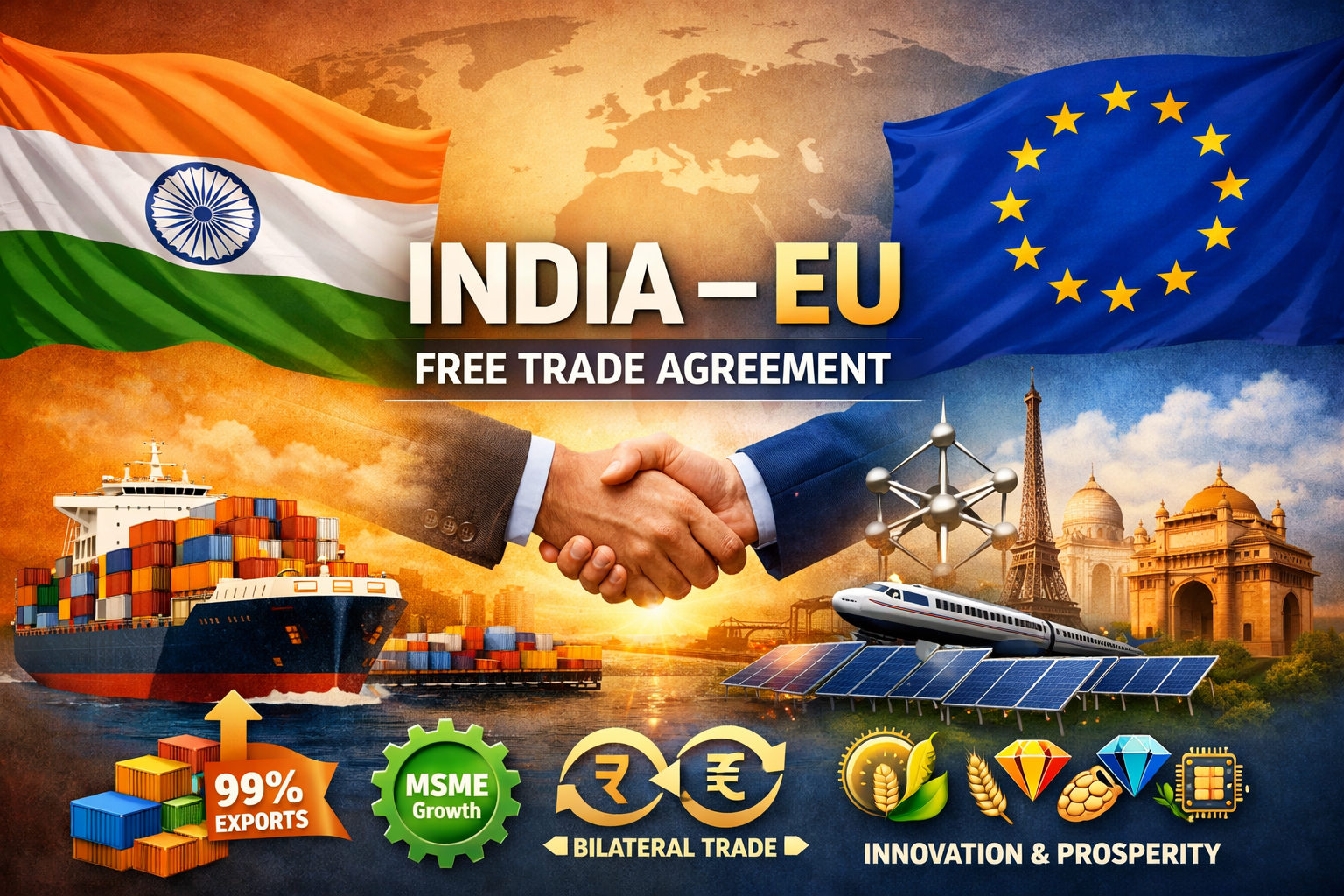
India–EU Free Trade Agreement
India–EU Free Trade Agreement: A Transformational Leap for Indian Industry, Exports & Global Value Chain Integration
India and the European Union (EU) have announced the successful conclusion of negotiations for a comprehensive Free Trade Agreement (FTA) — marking a historic milestone in one of India’s most strategic and future-oriented economic partnerships.
Designed as a modern, rules-based, and development-centric trade framework, the India-EU FTA responds decisively to evolving global supply chain realignments, geopolitical uncertainties, sustainability imperatives, and the need for resilient, diversified trade partnerships.
With India and the EU representing the 4th and 2nd largest economies globally, the agreement unlocks unprecedented opportunities across manufacturing, services, agriculture, MSMEs, digital trade, and innovation for nearly 2 billion consumers across both regions.
Scale, Market Access & Strategic Opportunity
With a combined market size of over INR 2,091.6 Lakh Crore (USD 24 trillion), the India-EU FTA delivers:
• Unprecedented market access for over 99% of India’s exports by trade value
• Predictable, rules-based access to 27 EU member states
• Protection of India’s policy space for sensitive and livelihood-linked sectors
• Strong alignment with India’s developmental priorities and employment goals
Bilateral merchandise trade stood at approximately INR 11.5 Lakh Crore (USD 136.54 billion) in FY 2024-25, with India exporting INR 6.4 Lakh Crore (USD 75.85 billion) to the EU. Services trade touched INR 7.2 Lakh Crore (USD 83.1 billion) — highlighting strong momentum, yet significant untapped potential.
Why the India–EU FTA Matters More Than Ever
Despite growing trade, India-EU economic engagement has historically remained below potential. The FTA now provides a structural pathway to:
• Position India as a preferred alternative to China-centric supply chains
•Enable long-term investment planning for Indian exporters
•Deepen MSME integration into European value chains
• Insulate trade flows from global economic volatility
This agreement elevates India-EU relations from transactional trade to a strategic, future-ready economic partnership.
Seamless Market Access: A Game-Changer for Indian Exporters
Preferential Access Across 97% of EU Tariff Lines
India secures preferential access across 97% of EU tariff lines, covering 99.5% of export value:
• 70.4% tariff lines (90.7% export value): Immediate zero-duty access
• 20.3% tariff lines (2.9% export value): Phased elimination over 3–5 years
• 6.1% tariff lines (6% export value): Tariff reductions or TRQs
Labour-intensive sectors — textiles, apparel, leather, footwear, marine, gems & jewellery, toys, sports goods, chemicals, plastics & rubber — currently facing EU tariffs between 4%–26%, will gain immediate competitiveness, supporting exports, jobs, and MSME growth.
India’s Tariff Offer: Balanced Liberalisation with Safeguards
India offers 92.1% of tariff lines, covering 97.5% of EU exports:
• 49.6% immediate duty elimination
• 39.5% phased reduction over 5–10 years
• TRQs for sensitive products like apples, pears, kiwi
This approach ensures access to advanced EU technologies, reduces input costs, strengthens domestic manufacturing, and protects vulnerable sectors.
Agriculture & Farmers: Growth with Safeguards
The FTA provides preferential access for Indian agricultural and processed food exports including:
• Tea, coffee, spices
• Grapes, gherkins, cucumbers
• Dried onion, fresh fruits & vegetables
Safeguards remain firmly in place for dairy, cereals, poultry, soymeal, and select produce, ensuring a balance between export growth and domestic food security.
The result: higher farm incomes, rural livelihood security, women’s participation, and premium global positioning for Indian agri-products.
Rules of Origin: MSME-Friendly & Supply-Chain Aligned
• Product-Specific Rules (PSRs) aligned with existing global supply chains
• Self-certification (Statement of Origin) reduces compliance burden
• Special provisions for shrimp, prawns, aluminium, machinery & aerospace
• Incentivises Make in India and value addition
Services & Talent Mobility: India’s Competitive Edge
The FTA secures EU commitments across 144 services sub-sectors, including:
• IT / ITeS
• Professional & business services
• Education, R&D, fintech, digital trade
India offers access across 102 sub-sectors, encouraging EU investment, innovation, and best-in-class services delivery in India.
A robust mobility framework enables temporary movement of professionals, contractual service suppliers, independent professionals, and intra-corporate transferees — with a roadmap toward Social Security Agreements.
Sectoral Winners Under the India–EU FTA
Textiles & Apparel
Zero duty access opens the EU’s USD 263.5 billion import market, accelerating MSME scaling and job creation.
Leather & Footwear
Tariffs reduced from up to 17% to zero, enhancing India’s competitiveness in a USD 100 billion EU market.
Marine Products
Tariffs up to 26% eliminated, boosting shrimp, frozen fish, and value-added seafood exports.
Engineering Goods
Preferential access to EU’s USD 2 trillion import market, empowering MSME-led industrial hubs.
Chemicals
Zero duty on 97.5% of exports, positioning India as a trusted supplier to the EU’s USD 500 billion chemical market.
Medical Devices
99.1% tariff line coverage enables cost-competitive entry for medical instruments and devices.
Gems & Jewellery
100% trade value covered, improving India’s share in the EU’s USD 79.2 billion import market.
Plastics, Rubber, Furniture, Minerals
Enhanced access fuels design-led, sustainable, value-added exports.
A Strategic Blueprint for Viksit Bharat
The India-EU FTA is more than a trade agreement — it is a strategic blueprint for:
• Export-led growth
• Employment generation
• MSME empowerment
• Global value chain leadership
• Sustainable and resilient economic development
Aligned with India’s vision of Viksit Bharat @2047, the agreement reinforces India’s emergence as a trusted, reliable, and indispensable global economic partner.