
US–Iran Truce Really Means for Global Trade — India’s Strategic Moment
The headlines say “ceasefire.”
Markets responded with relief. Oil prices corrected. Shipping lanes reopened.
But here’s the reality: trade doesn’t restart with a handshake—it recalibrates with caution.
At Unicorn Growth Partners (UGP), we believe this moment marks not just a recovery—but a reset of global trade architecture. And for India, this could be a defining inflection point.
1. The Illusion of Immediate Normalcy
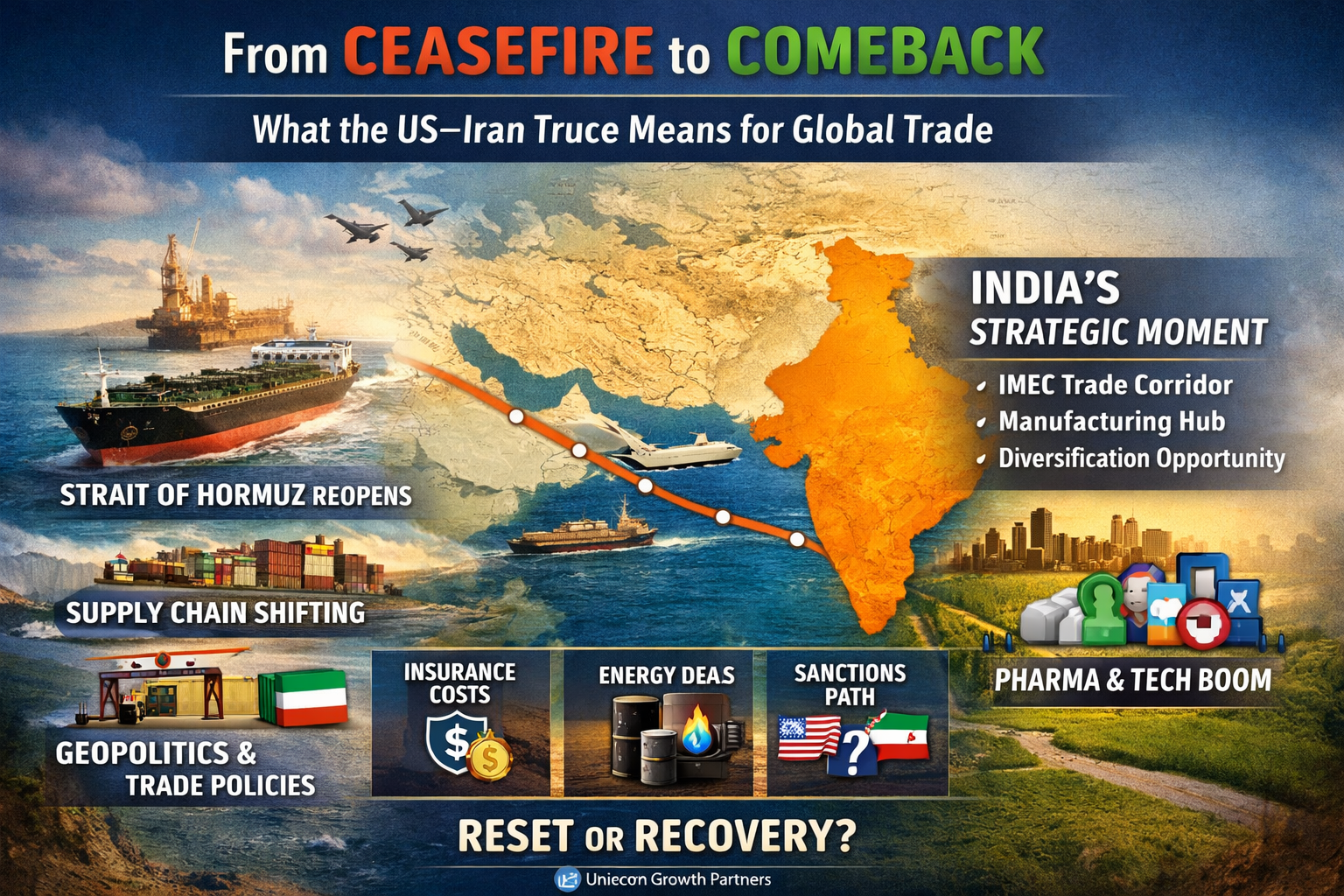
The Strait of Hormuz—artery for nearly a fifth of global oil—may be operational again, but trade confidence is not fully restored.
- War-risk insurance premiums remain elevated
- Shipping firms are adopting “wait-and-watch” deployment
- Energy buyers are still hedging supply sources
UGP Insight:
Global trade resumes in layers, not leaps. The next 90–120 days will define whether this is stabilization—or prolonged volatility.
2. Supply Chains Won’t Snap Back—They’ve Already Shifted
The conflict forced rerouting across continents—via Africa, Central Asia, and alternative maritime corridors. These are not temporary adjustments.
We are already seeing:
- Increased investments in India–Middle East–Europe Corridor (IMEC)
- Acceleration in China+1 sourcing strategies
- Strategic stockpiling across energy and agri commodities
UGP Insight:
This is not a return to the old system. It’s the emergence of a multi-polar supply chain network—more regional, more resilient, and more politically aware.
3. Trade is now a Geopolitical Instrument
The Iran episode reinforces a critical shift:
Trade routes are no longer neutral—they are strategic assets.
From potential Hormuz transit toll debates to evolving sanction frameworks:
- Maritime chokepoints are gaining pricing power
- Trade agreements are becoming security instruments
- Governments are actively reshaping import dependencies
UGP Insight:
We are entering an era of “geo-economics competition”, where trade policy is as critical as trade volume.
4. India’s Strategic Window: From Bystander to Bridge
For India, this disruption unlocks a rare opportunity.
Why India stands to gain:
- Reduced oil price volatility eases macro pressures
- IMEC positions India as a global transit and manufacturing hub
- Western markets are actively diversifying away from high-risk zones
- Pharma, chemicals, and engineering exports can scale rapidly
For pharmaceutical and the broader life sciences ecosystem, this translates into:
- Stronger export positioning in regulated markets
- Opportunities in global health supply resilience
- Strategic partnerships with multilateral agencies
UGP Perspective:
India is not just a beneficiary—it can become a stabilizing force in global trade flows.
5. What Happens Next: 3 Signals to Watch
UGP is closely tracking three indicators:
- Shipping insurance normalization timelines
- Energy contract renegotiations (spot vs long-term)
- Policy shifts in sanctions and trade corridors
These will determine whether we see:
?? A fast rebound
?? A phased recovery
?? Or a new equilibrium altogether
Final Take: This is a Reset, Not a Recovery
The ceasefire is a starting point—not a conclusion.
At UGP, we see this as a once-in-a-decade reconfiguration of global trade, where:
- Risk replaces efficiency as the primary driver
- Geography regains importance
- And emerging economies like India gain strategic leverage
The winners will not be those who wait for stability—
but those who build for uncertainty.
What’s your view: Are we heading toward normalization—or a fundamentally new trade order?
Send your comments/Views on info@ugpindia.com or visit www.linkedin.com/in/dr-priya-das-13197626