
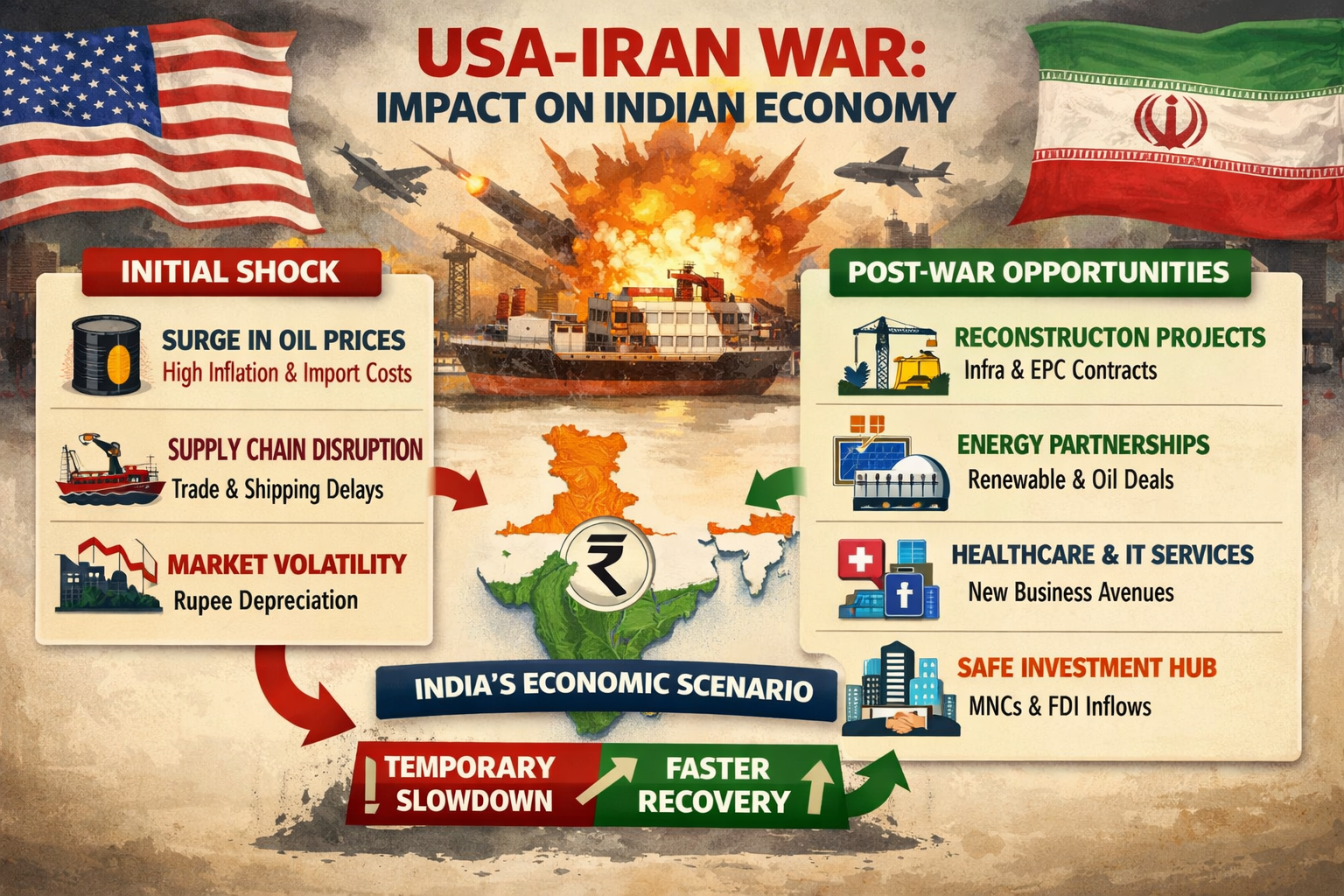
Impact of USA-Iran War on Indian Economy- Scenarios
Scenario-based view of what a US–Iran war (and a post-war, weakened Middle East) could mean for India’s economy, Indian companies, and India’s “safe country” investment narrative—and whether a fast bounce-back is likely.
1) India’s near-term macro impact (war phase): mostly negative, via energy + logistics
A. Oil & gas shock → inflation + current account pressure
-
India is highly oil-import dependent (~88% in FY2023/24; ~88% Apr 2024–Feb 2025), so even a temporary crude spike quickly feeds into the trade deficit, inflation expectations, and fiscal arithmetic.
-
Markets are reacting mainly to Hormuz risk: disruptions through the Strait of Hormuz matter because a material share of global crude and LNG transits there; analysts warn of $100+ oil if disruptions persist.
B. Freight, insurance, and rerouting costs rise
-
Even if India secures barrels, shipping rates/insurance can jump sharply during conflict, raising landed costs (and sometimes causing physical delays).
C. Sector winners/losers in India (war phase)
-
Losers: aviation, paints, tyres, logistics-intensive manufacturing, oil marketing companies (timing depends on pricing policies), and any sector sensitive to inflation/interest rates.
-
Relative winners: upstream energy (if any exposure), defense, cybersecurity, some commodities exporters, and firms with pricing power (case-by-case).
2) Post-war Middle East: “reconstruction + rebalancing” opportunities for Indian business
If the region is weakened and focused on rebuilding, Indian companies can win in practical, execution-heavy areas:
A. Reconstruction & infrastructure
-
EPC / project exports: roads, ports, airports, housing, hospitals, industrial parks, transmission & distribution, desalination/water networks, wastewater.
-
Engineering goods, cables, transformers, pumps, construction materials, prefab—India is competitive when speed + cost matters.
B. Energy system reset
-
Post-war, countries may accelerate grid hardening, fuel storage, renewable build-outs (solar/wind), and LNG/import infrastructure to reduce vulnerability. This creates space for Indian EPCs, electrical equipment makers, and O&M providers.
C. Healthcare & humanitarian-to-normalization cycle
-
Conflict typically increases demand for essential medicines, vaccines (where applicable), hospital consumables, diagnostics, and cold-chain—first as emergency procurement, later as system rebuild. (For Indian pharma, the opportunity is real, but payment risk and tender complexity rise.)
D. Digital rebuild
-
Governments and banks often modernize identity, payments, tax, customs, and cyber after disruption. Indian IT/services, fintech rails, and GovTech integrators can benefit—especially where cost-effective, scalable implementation is valued.
E. Food, agri, and supply chain
-
Middle East import dependence on food often rises during/after disruptions. India can expand rice, sugar, processed food, dairy ingredients (where allowed), and agri-tech services, but must manage domestic price stability.
Key constraint: post-war states can be cash-strained, so deal structures often shift to sovereign-backed projects, multilaterals, export credit, or PPP-style arrangements (rather than purely commercial orders).
3) Does “post-war oversupply = cheaper oil” automatically happen? Sometimes—but not guaranteed
Hypothesis—war spike → post-war price drop due to Gulf recovery + higher production—can happen, but it depends on 4 things:
-
How long Hormuz disruption lasts (days/weeks vs months).
-
OPEC+ policy choices: producers may prefer rebuilding revenues via managed supply, not a price collapse.
-
Infrastructure damage: if production/export facilities are damaged, supply can stay constrained even “after” the war.
-
Risk premium persists: even after ceasefire, insurers and shippers may price in residual risk for months.
So: a rapid fall in oil is plausible if the conflict de-escalates quickly and physical supply routes normalize—otherwise prices can stay elevated longer than expected.
4) Will India “bounce back faster” and look like a safe haven for global MNC investment?
Why India could look safer / more attractive
-
Diversification logic (“China+1”) strengthens when conflict risk rises in other regions.
-
India remains one of the few large economies with strong medium-term demand and a broad manufacturing/services base (investors debate execution, but the narrative is durable).
-
India has continued to draw gross FDI, even when net flows fluctuate due to repatriation/outward FDI dynamics.
Why the bounce-back is not “automatic”
-
India’s very high oil import dependence means energy shocks hit macro stability fast.
-
If oil stays high long enough, you typically see: inflation → tighter financial conditions → slower consumption/investment, plus pressure on rupee and fiscal choices.
Net: what’s the most likely pattern?
-
Short conflict + quick normalization: India takes a temporary hit, then rebounds relatively faster vs oil-importing peers if crude falls back and global risk sentiment stabilizes.
-
Prolonged disruption: rebound is slower, and the “safe haven” benefit may show up more in selective FDI decisions than in broad macro acceleration.
5) Practical “where Indian companies should aim” playbook (12–36 months)
-
EPC + utilities: water/desal, power T&D, grid protection, housing, hospitals.
-
Healthcare: essentials + hospital systems + cold chain; partner with multilaterals/UN procurement channels when possible.
-
Digital: cyber hardening, gov platforms, payment modernization.
-
Logistics & ports: rerouting and resilience projects.
-
Risk-managed market entry: use export credit, political risk insurance, escrow/LC discipline; avoid unsecured receivables in fragile states.
6) What India can do to convert “safe haven” into real investment inflows
-
Keep inflation expectations anchored during the shock (fuel tax calibration, buffers).
-
Accelerate energy resilience (strategic reserves, supplier diversification, renewables).
-
Speed execution on industrial corridors/plug-and-play zones—MNCs choose certainty.